he Brazil World Cup standings tell a story of unmatched consistency, but they also reveal a pattern that Brazilian fans rarely celebrate. No nation has won more World Cup titles—five—and no country has appeared in every tournament since 1930. Yet, the raw standings data hides a decline that started long before the 2014 Mineirazo. Between 1958 and 1970, Brazil won three World Cups in four cycles, a period of dominance that skewed expectations for generations. In the five tournaments since 2002, the Seleção has reached just one semifinal (2014) and exited in the quarterfinals three times. The standings still list Brazil atop the all-time points table。but the gap is closing fast. Germany's consistent deep runs have narrowed a margin that once felt unassailable. I remember checking the FIFA rankings in 2018 and noticing Brazil had slipped to second behind Belgium—a position that would have been unthinkable in the Ronaldo era. The data doesn't lie, but it doesn't tell the whole truth either.Look at the group stage records, and the Brazil World Cup standings look even more dominant. The Seleção has lost just two group matches since 1966—a 1-0 defeat to Norway in 1998 and a 2-1 loss to Cameroon in 2022. That's 32 group games with only two defeats. But here's the catch: group-stage dominance hasn't translated into knockout success. In the last five World Cups, Brazil has been eliminated by European opponents four times (France 2006, Netherlands 2010。Germany 2014, Croatia 2022). The one exception was Belgium in 2018, also European. That's not a statistical fluke—it's a pattern. European teams press higher, defend in compact blocks, and exploit Brazil's full-backs pushing forward. Tite's 2022 squad had the talent to win it all, but Croatia's midfield controlled the tempo in extra time. I watched that match in a packed bar in São Paulo, and the silence after Neymar's goal was replaced by a collective groan when Petković equalized. The standings say Brazil is a top seed. The knockout record says otherwise.Qualifying campaigns offer a different angle. Brazil has never failed to qualify for a World Cup。and the CONMEBOL standings are usually a formality. In the 2026 qualifying cycle, however, Brazil sits in fifth place after six matches—a position that would have triggered panic in previous eras. The team drew with Venezuela and lost to Uruguay, results that exposed a midfield lacking creativity and a defense vulnerable to quick transitions. Coach Dorival Júnior has rotated the squad heavily, searching for a balance that has eluded the Seleção since 2002. The Brazil World Cup standings in qualifying don't always predict tournament performance—Argentina struggled in 2018 qualifiers and still made the round of 16—but they do reveal structural issues. Brazil's away form in South America has been shaky: just one win in the last five qualifiers on the road. That's not a blip. It's a trend that European scouts have noticed.Historical standings also show how Brazil's World Cup identity has shifted. In 1970, Brazil won with a team that mixed samba flair with tactical discipline—five No. 10s on the pitch, yet everyone tracked back. By 1982, the team was beautiful but naive, losing to Italy in a match that still haunts Brazilian fans. The 1994 and 2002 titles were built on defensive solidity and clinical counter-attacks, not joga bonito. Fast forward to 2026, and the squad is caught between identities. Vinícius Júnior and Rodrygo thrive in space, but Brazil's build-up play is slow and predictable. The standings don't measure style, but they do measure results. And the results say Brazil is no longer the team others fear in knockout rounds. France, England。and Spain have overtaken the Seleção in betting odds for the next World Cup. That's a seismic shift from 2002, when Brazil was the clear favorite.
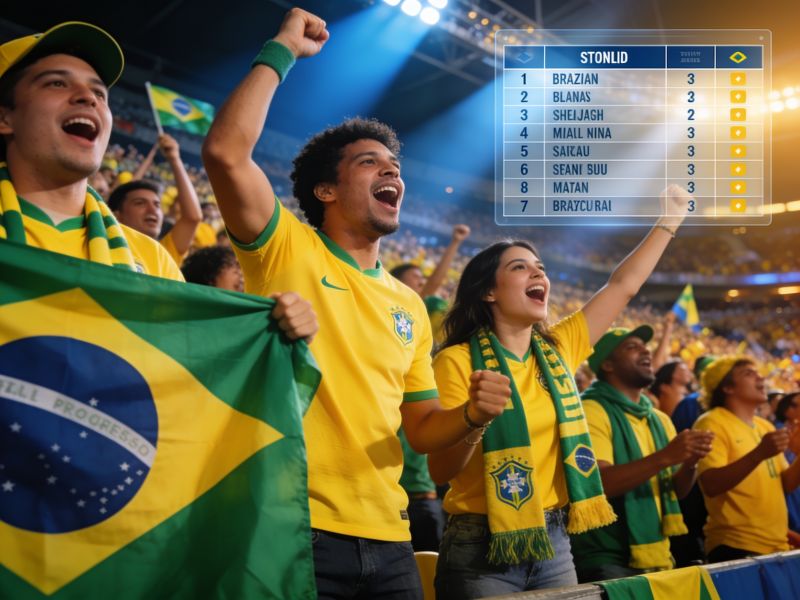
What would change the trajectory?A coherent tactical plan, not just talent. Brazil's youth teams have won the last two U-20 World Cups, but the transition to senior football remains bumpy. The Brazil World Cup standings will always look respectable—too much history and too many resources for a collapse. But respectability isn't what Brazilian fans demand. They want a sixth star. The data suggests it's possible but not probable without a serious overhaul of how the team approaches knockout matches. I'd argue that the next qualifying cycle matters more than any friendly. If Brazil finishes outside the top three in CONMEBOL, that's a warning sign no standings table can hide. For now。the all-time points lead is a comfort blanket. The next tournament will show if it's still a shield.